art · Art & Writing

The Number One Thing that Changed my Art

Hello Stranger.

If you were here right now, there would be clothes and trash on the floor, and dishes piling up in the kitchen. You would detect a faint light in the window, but the curtains would be drawn, and the door locked because I did not trust the night. For the first time, you would see bills and notices with my personal information littering side tables and flung haphazardly on the kitchen table and under it. But what would I care? The dangers are outside. You are inside. You would feel vaguely ill at ease, and I would be grateful that you felt it too.

There would still be food and something to drink.

And it would be a good night to discuss the subject of art.

My art changed forever when I stopped trying to make masterpieces, and started making things that were accessible.

There are two aspects to this. The first part was mental.

About three New Year’s’ ago, I bought myself a nice sketchbook. I had very specific plans for it, it was going to be used as a field guide for a world I was building, hoping to make a book. A list of ‘flora and fauna’ and the corresponding illustrations. I painstakingly researched medicinal plants, sketched and painted them, and wrote descriptions of them describing how they would apply in the other world. I got two pages done. I didn’t touch the sketchbook for the next year.

I was proud of the art! In fact, I still really like what I created. But it was stressful. It was high effort, and joyless. I was working full time and in college, and when I got home, I was exhausted.

It all changed when, a year later, I sat down to draw with my little sister and sketched a frog, a little cottage, and some mushrooms. And then it looked empty, so I splattered it with blue and green paint. I liked those.

Just like that, the sketchbook was ruined. It was no longer going to be used for flora and fauna of one specific world.

Now, this doesn’t bother everyone, but for someone like me, it made my skin itch. I felt a vague but intense sense of shame and guilt for straying from my original intent. I was a flake. And my story would never exist.

Let me just say, I have made more art, and more bright, happy, interesting artwork, and sewn together more stories in that sketchbook than I ever did before. When I had to quit my job, move states, and stayed in a room, sick with long-covid for three months, I made art. Not beautiful, detailed portraits. Not things that took my energy. I drew simple lines and painted in bright colors. I used whatever I needed to ‘cheat.’ Whatever tools could help tell the story that I hadn’t allowed myself to use before. And I didn’t freak out when sharpies bled onto the pages behind them. (That was a big deal for me.)

Instead of stressing about what my human characters looked like, I just drew a scraggly little guy in pen, and painted him in bright colors, and wrote him a little blurb in a pretty font. Instead of meticulously planning a page, I drew a general idea of what I wanted and splattered paint all over it. It didn’t have to be ‘the exact mushroom from my head,’ it had to be a mushroom. It didn’t have to be a perfect van, it had to be a van on a misty mountain with the words, ‘I would like to live in a van and drive through the mountains one day.’

I know I’m rambling, but honestly, how often do we hold ourselves back because we’re afraid that either our art will look imperfect, or that the imperfections will look like us? Art is one of the few areas in life that I don’t just carry shame and it eats me alive that other people do.

For the next week, what if you drew little comics with stick figures. What if you painted abstract figures or splattered colors. What if you looked at it without criticizing yourself so harshly. What then.

The second part was physical.

After long-covid, I am chronically exhausted. I am often sad or numb, and you know what, I was before too. But I can’t just ignore it anymore. When I get sick now, I stay sick for a long time. I feel like I have so little within me.

Babe, if you have a funny joke in your mind but it can only happen in a certain scenario, write it down. If you want to sketch Pete Davidson on a receipt from the Chinese restaurant, do it. If all you’ve got in you is a weird little guy in a striped sweater, but he’s there a lot, get him out on paper. Draw stick figures. Honey, it’s okay. The art that I make when I have almost nothing, is the art at the bottom of me.

It changed my life.

Just create what’s accessible to you. It’s okay.

Anyway, much love to you. As you know, my name is not actually

–Mabel
Art & Writing

Plastic Forks, Banana Splits, and Bright Spots

Hello Strangers.

Along the coast of Maine, sharp breezes and dark skies close in as summer warns of its own demise. When the tourists leave for the season, the population of a small, isolated town shrinks to three thousand, and the locals are left alone with the cold and dark. The sea taunts a young woman suffering personal tragedy yet again, in Megan Miranda’s ‘The Last House Guest.’ And I think to myself, man. This girl could use an ice cream.

A while ago, I worked at a sandwich shop and it was the happiest time of my life. And I was determined to be happy. It was during Covid and our supply chain regularly fell behind on orders. Bags were missing, straws, cups, lids, salad containers, et cetera, and we made do. It wasn’t a particularly big issue. But every time my manager would walk up with a box of bags to open, I felt my face light up like some cross between a Christmas tree and a clown. His face would twist up in response and he’d ask,

“What are you so happy about?”

I was happy about the bags. Obviously. What else was I supposed to draw frogs on. 

I once went to the grocery store coffee shop on our strip and picked up a fork. My glee was boundless. I think I giggled. The barista, Collin, looked at me with bewilderment and asked, 

“You okay over there? You just looked at the fork like it was God.” 

Well no, Collin, not God, let’s not get carried away. And, yes, Collin, I’m over the moon. Last time I came here to eat an entire-one-dollar-pie-that-I-didn’t-buy-from-you, you were out of forks and I had to buy a full container from someone else and come back. Which I can’t believe is allowed. 

And that’s very close to what I said, with a Joker grin plastered across my face. And the truly spectacular part of this was that it happened every day. And I was genuinely joyful, every day. 

As I’ve mentioned, I’m in a bit of a rough patch right now, but! Yesterday, an opportunity came my way. I was gifted a banana split and let me tell you, 

Bright Spot.

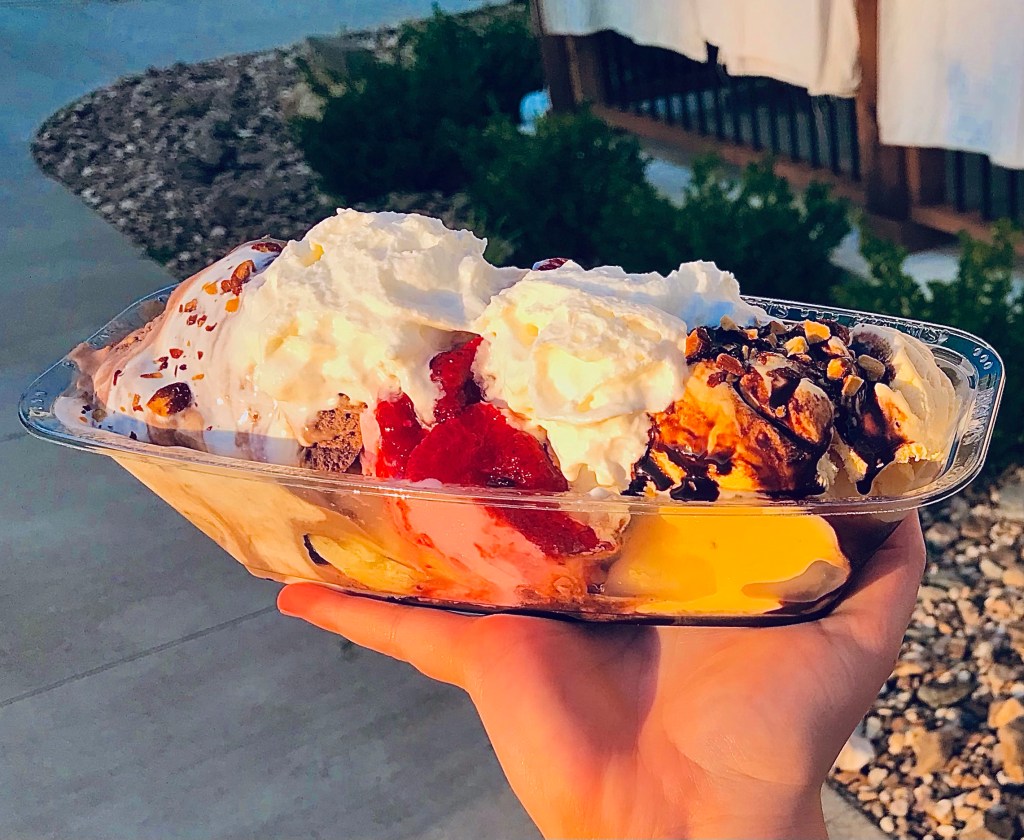
One chocolate scoop covered in marshmallow sauce, one strawberry scoop covered in sugared strawberries, one vanilla scoop covered in fudge sauce and nuts. A banana underneath, and all topped with whipped cream.

In my mind I could hear ‘Top of the World’ by the Carpenters playing. And because it’s in the movie, ‘Dark Shadows,’ that’s what I thought of. The happy song laid on top of a deep blue world, just a little twisted. And I thought, 

That movie would be so much better with a scene of someone really enjoying a banana split. Bright spots.

See, the movie was funny. It was a dark comedy, and I understand why there were no yellow-lit summer scenes including a frozen treat. But in that moment, I understood there could have been one. And there is a good rule of thumb for story writing here: 

 Nothing lasts forever. 

In our writing, we should break up monotony from time to time. If the story is one filled with gloom and danger, you must have authentic moments of joy and comfort. If your story is one of light and glee, it should be punctuated by a sadder perspective. The holes we punch in the paper are what make the world, like tears in the sky, making our constellations. It’s all the small things. Whether good or bad, the small things will build your story, and those moments need to be there, lest they be forgotten.

An Absolutely Fantastic Banana Split

Happy writing, Strangers.

With all the love I have,

–Mabel

Art & Writing

Tolkien Skies

Hello Strangers,

I’ve missed it here.

For the sake of the story, regardless of where you are, let’s pretend that it’s dark outside. You’re sitting across from me at a round wooden table in a country kitchen with a low watt bulb. It’s a bit depressing, but very human, and despite the heavy feeling, you also feel at ease. We have mugs of tea in front of us whether you enjoy tea or not, because that’s what I served. It has honey in it, and a spoon. And last of all, I am a woman of incalculable age, I could be young or older, and my hands… My skin is stretched over muscle and bone in such a way that somehow implies I am tired. So tired. When you look at my face, that skin is stretched too. And all of a sudden, I am not just tired.

Do you see what I want you to see?

For a time, as a teenager, I lived in a desert. I hated it desperately for years because during the day, the sun washed out all the color from the earth. Even green things looked grey. The sky looked almost white, and the color of the sunlight was closer to white than to a bold, happy yellow. I would stay inside for weeks on end.

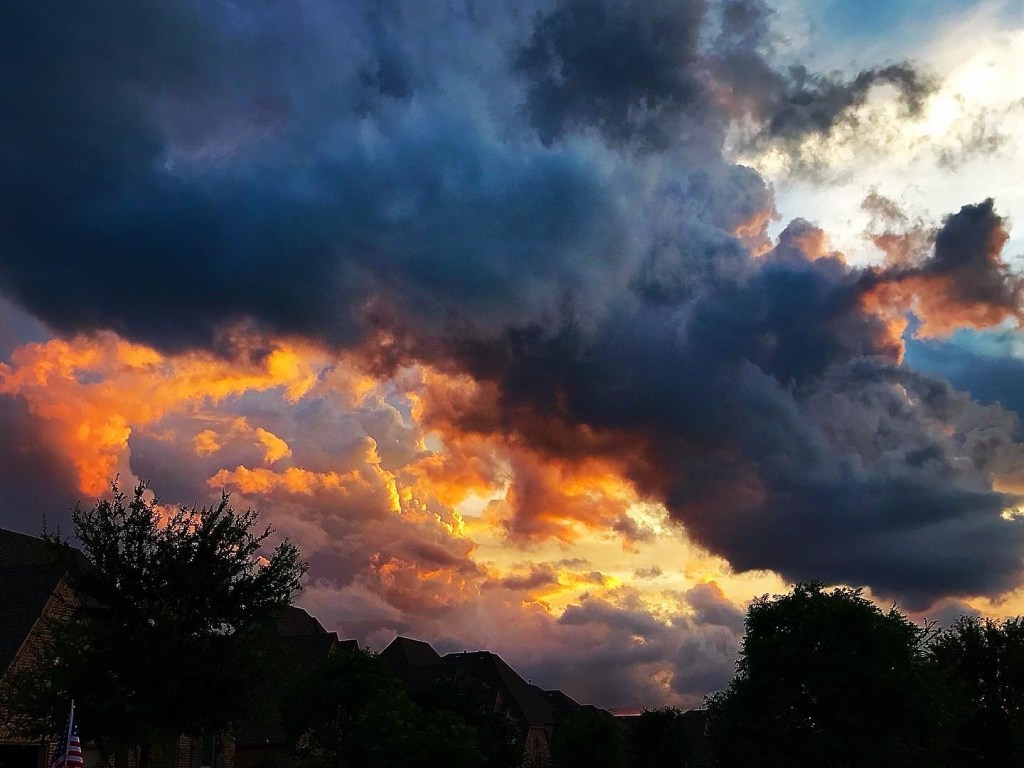
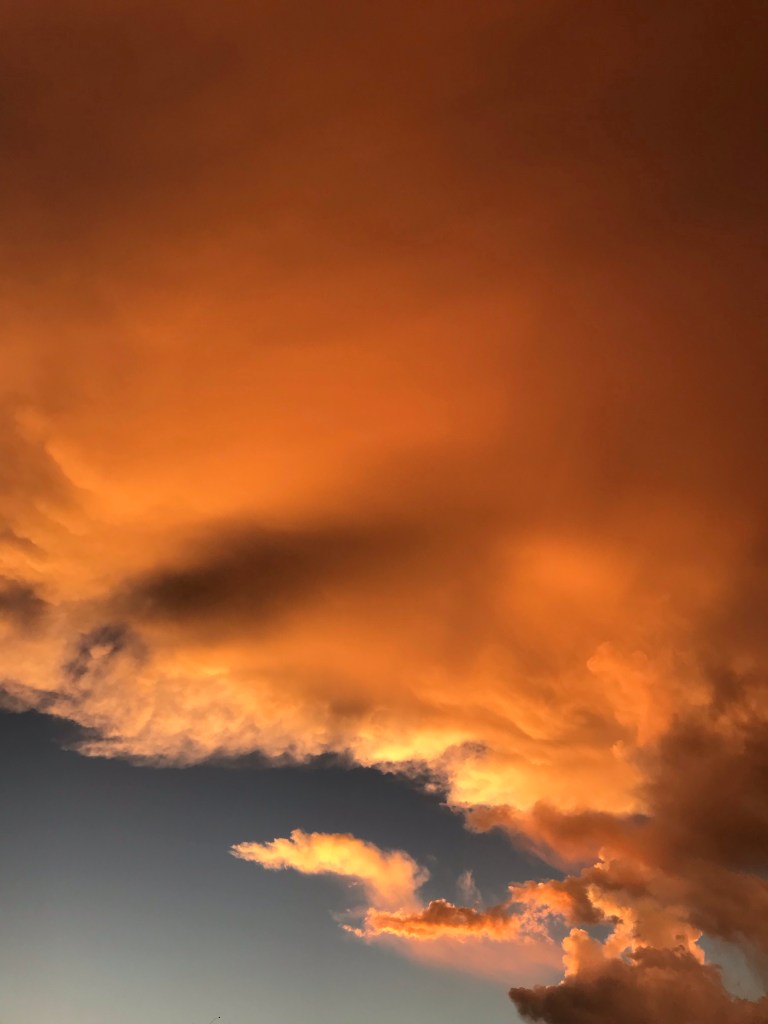
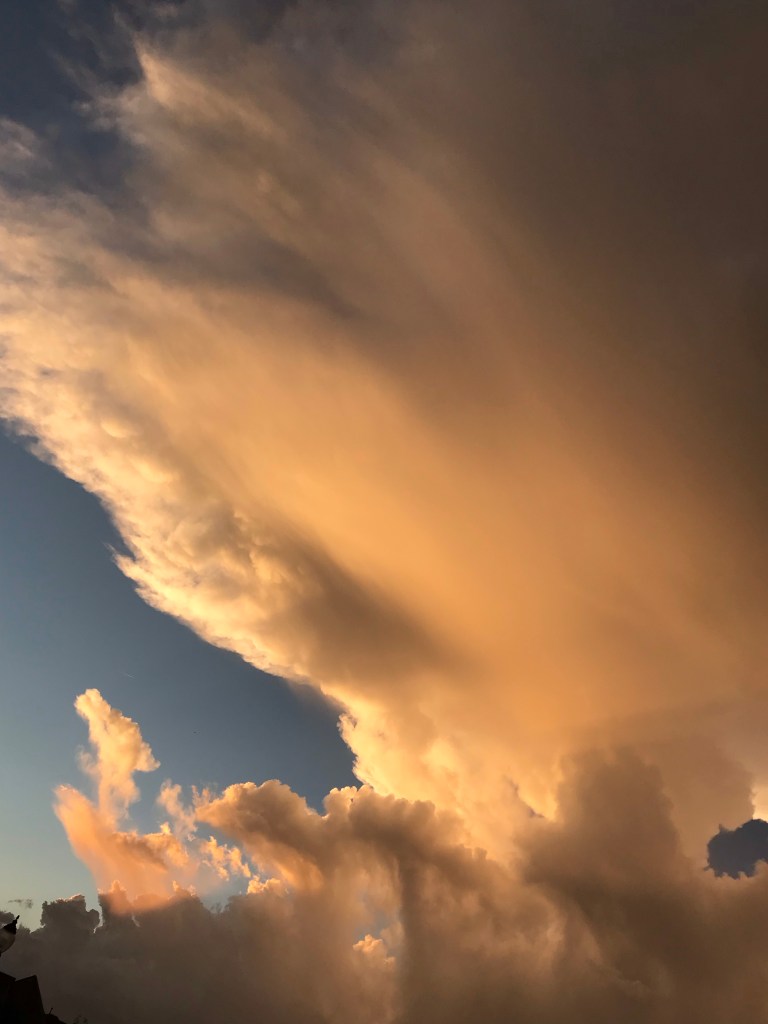
After my uncle died, I would sit out on the wall and talk to him. I think it was during that time that I saw the evening sky in the desert. And that’s when everything changed. For a few minutes a day, I was at the circus. I was in a fantasy world. The clouds looked like cotton candy, or storms made of fire, or some other, incredible event.

Examples of Tolkien Skies

I named them Tolkien Skies, after J.R.R. Tolkien. From that moment on, I realized how much fiction had informed my views of reality. Tolkien’s skies and mountains were in the desert, but my old house in North Carolina was the setting of Ink Heart by Cornelia Funke. I look at trees and to this day I still see Dr. Seuss. Fireflies lead to magic portals, and in the field past my backyard, a barefoot woman I wrote met God.

The place I am now, it’s been a nightmare for me. I’ve stopped looking for good and I feel consistently heavy. The things I love hold less appeal. There is no physical escape from the sadness. Everywhere I look there is suffering and hatred. But that’s not the whole story.

You see, since being here, I’ve built more stories than I have I think anywhere else. I haven’t written to you yet about the neighbors whose window inspired my blog’s tag, ‘a window in the dark, a cup of tea waiting in the kitchen’ and their blue, orange, green, and gold porch lights. I haven’t told you about the lore I built around the moon. The movie Hugo was such a blessing to me, with its beautiful color palette and the Station Master in the film. I’ve gotten two dogs from this place and written more than 60,000 words in one year (a record, I think!) I learned how to bake bread, and I never would have started this blog if it weren’t for this difficult, difficult place. I began volunteering, and a very big opportunity has come my way. I’ve sat at city council meetings. And I’ll move again soon.

I can’t deny it. I’ve gotten sick again. I’m not functioning properly on any level. But as much as I want to deny it, this place has been a blessing from God. Many blessings. A new chapter is coming. And in the meantime, there has been just enough of different worlds to keep me sane while I stay in this one. I have more posts coming soon, mainly about writing and hopefully some about art (I have access to my photographs again! I will explain more in my next post!)

When things get dark, we need to search for God in the darkness. Where is He? Thankfully, I think He sometimes shows us redemption in the stories we tell ourselves. So much of my world is painted.

Thank you for sitting with me and letting me monologue. There’s a change of clothes in the guest bedroom towards the back of the house and clean sheets. I’ll leave the light on for you, but I’m going to bed. I am very, very tired.

All my love dear,

—Mabel

Art & Writing

The Rising of Bread

Hello Strangers,

This post is not about breadmaking, but about something I haven’t been able to stop thinking about since I started baking bread: the resting period.

If you’ve ever read the Grimm Fairytales, you may have also been told of how two brothers traveled the countryside in a marvelous adventure, collecting their stories in taverns, from gnarled old women in remote villages, and on street corners where charlatans spoke in hushed tones that feigned secrecy, but would instead draw their crowd. It may surprise you to learn that actually, a large number of their stories were collected just across the street from their house; from their little sister’s friends. Their second, absolutely integral source, was an upper class woman and her family who had been collecting them fastidiously throughout their lives. 

In her book, ‘Clever Maids’ (which I highly recommend) Valerie Paradiz goes through the lives of the Grimms, and also through the lives of these women and their work. 

During this time, men and boys down through the middle class had more access to education than at any time in their recent history and women continued to work in the home, often without access to books and certainly not to scholarly papers and journals. But while men were gaining education and scholarship, women were continuing the oral tradition, often making alterations to old stories and creating their own. While the reasons we remember the brothers and not their sister and friends would be a fascinating, if disheartening discussion, this post focuses on the women themselves and the way that they lived to cultivate this culture of storytelling.

It has been posited by historians that one of the reasons there are so many spinners and weavers in folklore is because it was the women weavers who told the stories, hence the terms “spinning a yarn,” and “weaving a tale.” According to Paradiz, women often told stories as they did repetitive work such as weaving, embroidering, laundry, or cooking, much like we listen to podcasts or watch dramas while we work today. 

When making bread, the same ingredients combine, they are worked and kneaded, and then they are left covered in a dark spot to rest. And as the dough rests, it rises. I think these women had their chores and schedules like ingredients and a sure routine, pounding them out like bread on a counter. Though at times it may have been boring or lonely, and limited, the quiet lulls cultivated the stories. The quiet created the rest period. Their boredom forced them to imagine, and their motherhood forced them to teach. Their girlhood forced them to invent things that men made no time for. And because of them, we have thousands of stories that may otherwise have been lost. Entire cultures fossilized in living voices until they would be written down. 

I think this is where things get confusing today. In 2023, makers, creators, and artists are encouraged to work in a way that generates the most content in the least amount of time. No longer artisans and craftsmen, they are considered ‘content creators’ and manufacturers. This model is based on the notion that all art, whether it be singing, drawing, dancing, or storytelling, is only justified if it is made to generate a profit (and if you are going to make a profit creating today, it’s very hard to do without following this formula). What this has led to within art communities is overbranding, repetitive and inauthentic content, and lack of satisfaction and burnout as artists. 

There was so much about the past that I wouldn’t want to return to…But the idea of skilled and strenuous—yet simple—labor, and a model of creation and play simply for the sake of itself is something I think many of us could benefit from. 

I can’t say one way or another, and I’m sure there are male creators that would benefit from this type of creation as well, but it makes me wonder if women create differently, and have different motives for doing so. Would this be more beneficial for one sex than the other? All I know is that without work to distract from my creativity, I stagnate as an artist and a person. And without imagination, I am unable to work. As a creator, I think it’s time to take back our craft and decide for ourselves what it will mean to be artists. 

Art & Writing · cottagecore

Dear Strangers: A Letter on the Power of Writing

Hello Strangers. 

Years ago, I lived with my family in the desert. My uncle, who lived in Arkansas, passed away. He was young. He was my favorite. I hardly knew him, a common theme with my extended family. I don’t think anyone realized how much I loved him, and no one really understood my reaction when he died. Around the time of his funeral, I was sitting on the bough of a tree, the sun shining, a breeze blowing, and I was talking to him. Saying goodbye, I think. Trying to make it final, so maybe I’d stop saying it over and over again like I had been. I told him I loved him and maybe that I’d miss him—I don’t remember—and all of a sudden I heard a voice in my head that sounded kind of like him, but forced. Just a bit wrong. In the moment I truly thought it was him saying goodbye. I don’t know about the voice, or what I saw next, but I looked up and he was standing in the sunlight, white shirt, his cowboy hat and boots. He smiled. And I smiled. And then he was gone. 

Well that was Oklahoma and Arkansas, but we went home after the funeral, and every night I would sit on the stone wall outside our house and watch the lights of the city begin to blink on while the sky changed from blood orange to a lilac mixed with smoke. I’d pray. Have make-believe conversations with my uncle.  And he’d sit there silently on the wall. 

All those years ago and no one ever knew. I guess I never communicated that. And no one ever asked what I was doing.

It’s years in the future, and I’m asking a friend their opinion on my taste in men. (One in particular, fictional, embarrassingly.) She said that I live life as a “good girl” and subconsciously I wanted someone dangerous as a way to explore my dark side. And I was struck by…just how wrong that was. (Now it’s not her job to psychoanalyze me, she’s my friend not a therapist, but still. I was very surprised.) I ended up watching ‘Delivery Man’ with Vince Vaughn a little bit later and it clicked. I was looking for and found something very specific in all of these people, and once I figured it out it made perfect sense. But apparently, I had failed to communicate what I wanted in a way anyone understood, ever. And I began to realize that people had different perceptions of me than what I thought I was putting into the world.

I can think of a million instances where I’ve been misinterpreted and misunderstood. People didn’t understand what I wanted or what I was trying to say. Why I cared about something or someone. That I was angry, or that I was in love. People don’t always understand. This is one of the first things children learn in life, and one of the first things we relearn as adults. Which brings me to writing.

Writing allows me to build my own world where I can say what I mean to say. I’ve struggled with the difference between Mabel and this space, versus the way that I am in real life. But the truth is that this is so much closer to who I want to be. And this is where I am able to say what I want to say. 

Right here, right now, you and I are sitting at the kitchen table. It’s dark, and smoke’s coming from the chimney and creatures that don’t exist come to visit me. Sometimes my cottage is more real, and there’s a garden in the back, and I think about tips I can give so we can both garden better. Sometimes I’m a ninety-year-old woman at the edge of the world, and you’re a battle-scarred mercenary, but you know my house, and I know your silhouette in the darkness. I don’t really know who you are, I can’t see you. But can you see us? 

This is how writing frees us, giving us the ability to say what we mean. And by the way, thank you for reading about my uncle and the stone wall. I’ve wanted to tell someone for a very long time. That’s all for now.

However you see me, Strangers,

–Mabel

Oh, P.S., I realized that my slogan is “a window in the dark, a cup of tea waiting in the kitchen,” and I’ve really failed to give you all any recipes. If you were here, I’d make food, so I’ve got a soup recipe coming, and after that some springtime desserts. Much love.

Art & Writing

The Medium of Story…

Hello Strangers, 

It is officially spring! Has been for a week. Flowers are blooming with the leaves on the trees, bugs are back, jumping and buzzing above the wildflowers and grasses, and the sun has gotten some of its color back. It’s looking to be a beautiful season. 

There are so many stories in nature. One area of the forest holds standing water, mosquitoes, and the moss which will continue to live despite  the summer heat, another has a babbling brook and Black Eyed Susans that the deer come to drink at, still another holds a meadow, which somehow always manages to catch the sunlight, gold in the middle, and green at the edges from the filter of the leaves. 

That’s an apt metaphor for story as well. I read somewhere that a lot of people today have stories inside them, but assume they have to turn them into novels. That simply isn’t true, there are a thousand ways to tell a story. They don’t even have to be written

My favorite living artist is named Robin Sealark. She has an excellent YouTube channel under that name, and she was the person who taught me to experiment with everything in my art. To sketch, paint, and tell story with abandon. Art-a-thons and studies, realistic and stylized…She explained that in the first year of an art degree, students work in the studio for hours a day, months on end, trying everything. Acrylic, oil, gouache, watercolor, graphite, charcoal, chalk, crayons, sculpting, digital mediums…And then after they’ve tried everything, they specialize.  

So, in a generation that has access to everything, do we limit ourselves? 

I’ve started a journal, and everytime I have a story idea, I write it down. I think about it, and then I also add what medium I think it’s best suited to. Some of my stories are very visual, so I pick comics, graphic novels, or animations, (animations are obviously out of reach for a lot of creators, but I still like to list it as an option!) and some stories enter my mind and I imagine telling them around a campfire or as a bedtime story. These might be better suited to podcasts, songs, or a simply written script I can memorize and tell as a bedtime story, or at a campfire. Not everything has to belong to everyone. 

You can write novels, short stories, poems, tv scripts, you can make mixed media stories like comics and graphic novels, you can make sculptures and paintings that encompass a story, dance, song, podcast, blog, youtube channel. You can cook stories! You can weave a story! Literally. 

What I’m asking is that you don’t limit yourself before you’ve tried everything. Even the people who write medical textbooks and grants are telling stories. Marketing is storytelling. Landscape paintings are stories. Embrace all of the mediums. Who knows, maybe you’ll find a new way to create. 

Happy Spring! 

–Mabel

Art & Writing · Writing

What I Thought Writing a Book Would be Like

Hello Strangers,

Welcome! How have you been? Personally, I’m glad to be back here; this blog feels like the inside of the cottage I have in my head. This post will discuss some of the preconceived notions I had about writing a novel, and what ended up being true instead. (There’s a note about my future plans for the ‘Art and Writing’ section of my blog at the end.)

Photo by Min An on Pexels.com

Writing would be a linear process.

I thought that if I had 30,000 words written, that would mean I’d be about a third of the way through my narrative. In other words, writing a book would be like reading a book and all the pieces would fall neatly into place.

What actually happened:

With 30,000 words written, I have a rough beginning, middle, and end. As I continue, I’m building in more character development and foreshadowing, and after I work through those, I plan to add more depth to the plot and detail to the world building. After I finished that first draft, I wrote quite a few things out of order as I realized I needed them.

I’d only have one outline.

I assumed that I’d use one outline that detailed the entire story, and maybe I’d add to that if I needed to.

What actually happened:

I have a main outline which enabled me to write my first draft. However, when I read through the story I realized that it needed a lot of new scenes to build up my character interactions. These were hard to write though, so now when I come to particularly difficult scenes, I outline them and it helps me avoid getting writer’s block. 

I’d only need two or three drafts.

I read in a murder mystery recently about a minor character who’d been working on her novel for ten years. The main character thinks to herself that the manuscript is probably unreadable and should be scrapped as it can’t possibly be salvaged. For better or for worse, that stuck with me as I began my first novel. I’ve been scared of overcomplicating things and taking too long to write it, so I thought I’d give myself a limit of three drafts and two years to finish this story.

What actually happened:

My first draft included the skeleton of the plot, it has all of the characters and their relationships, as well as the setting. It’s the bare bones of everything. In my second draft, I’m focusing on the characters. In the third draft, I plan to add the findings from my research and strengthen the plot. Now I know that I’ll most likely need a fourth draft for restructuring and fixing continuity errors, and a fifth one for true editing and finishing touches. Those numbers are the minimum. This is my first big project and even if it fails, it will teach me so much about myself and my process, so I don’t need to limit myself with this. I need to breathe and figure out how I do things.

I thought that real writers always push past writer’s block.

What actually happened:

I’ve discovered that for me, it is beneficial when I get stuck to step back from my work. Sometimes I give myself a few minutes, a few hours, a few days to work on a problem. I might write a scene outline, I might talk through that scene with my sister. I might delete what I’ve written and start again. And sometimes, I truly disconnect and do laundry, cook, or handle business. In the end, I sit down and write the worst version. After it’s written, I feel better about it, and I can move on. That’s my editor’s problem in a few months. (I’m my editor.)

I expected people to care more…

Some writers find or build support systems, or writing groups, or other things of that nature. 

What actually happened:

I don’t know how to do that yet, I haven’t yet, and while my family and friends are very supportive and loving about my stories, most people don’t want to hear the broken-sentence-synopsis of a book that doesn’t exist yet. The author is the only person that has all the miniscule details in their mind, so asking others their opinion of them won’t usually help you. Even if you want to include others, they’ll likely be busy with their own lives and it’s easy to feel isolated. Spend time with those you love, do your work and practice your hobbies, but remember that it’s okay; you’re writing because you have a story to tell, or want to explore your personhood, or you just want to say you’re a writer. It’s alright that a good bit of it happens alone. Keep going.

Those are the notions that have been challenged so far, I hope they can be helpful to you in your writing! What I wanted to say about the future of this section is this: I love art, it was my favorite creative outlet before writing, and the two are probably equally important to me now. Within the next year, I plan to release far more posts about art (painting, drawing, sketching, the creative process, etc.) that I have been able to thus far. For now, there will be more posts about writing. I’m excited about what the future holds!

Until next time,

–Mabel

Art & Writing

Small Dream Saturday: Entry 6

Hello Strangers.

Last week I went to bed dreaming of what it will be like if I ever do own a summer camp; specifically some of the projects I want the kids to do, and I again thought about all of the different ways to build forts. I thought of two ideas specifically:

Years ago, I found a project where you make an igloo out of plastic milk jugs. You glue them together side by side, flat bottoms facing out, lids facing in. I thought about how if I were a child, that would be wonderful to build, but the lids might break my immersion. So, then I thought, what if the lids were painted and stenciled with special designs? What if when you twisted off the caps, there were rolled scrolls on the inside of the bottles? 

And then I realized you could put anything on the scrolls; puzzles and ciphers, challenges to help the community or learn, information on old myths, legends, and landmarks… But that’s not all! You could decorate the outside of the structure as well, any way you wanted, but I thought it would be neat to cover the base with soil and grow some flowers, as well as paint the jugs with moss mixture. You could make a mud dome, decorate it with rocks, the possibilities are endless. What a cool clubhouse, right?

The second idea would use cardboard milk cartons as brick molds. I would love to make colorful, translucent bricks, however, I ran into a problem. The only relatively ecofriendly and inexpensive method I found for making translucent bricks was to freeze water (like in the case of a winter fort.) So, what I thought of as an alternative was to use rectangular water bottles that had been painted with a mixture of glue and paint, so they’d be colorful and look reminiscent of stained glass. We’d use those to build a low, three-sided wall, and then the kids would make a roof out of plastic tarp they colored and designed stretched over a frame. I’ll have to research the effects of colored, filtered light, as well as how plastic leaches into the ground…But I think it has potential to be a great summer camp project!

Those are this week’s small dream projects. I only hope that one day they’ll be possible. If not for me though, maybe you and your kids; anything is possible right?

Happy Saturday and Happy Dreaming,

–Mabel

Art & Writing

My Experience Writing the First Draft of a Novel

Hello Strangers.

I’ve done it.

Last Tuesday, I completed the first draft of my first novel! It’s a day I’ve dreamed of since the seventh grade, and finally, it’s done. The draft itself is kind of abysmal; it’s very short, the characters need more work, the plot needs filling, etc., but now that it’s completed and I’ve had some time to think, I’d like to write about the process of making it.

The Ignition

“Steal like an artist” is a maxim that has caused controversy within creative communities for at least a couple of years now, but unabashedly taking inspiration from multiple sources (that part is important) to create something that’s yours is what creation is…So when my favorite side character died in a tv show I loved, I had to steal him…And change almost everything else. As soon as he died, a story immediately began materializing in my mind. The characters shifted, the setting changed drastically, the plot would come later, but there was the inspiration. Of all the story ideas I’ve had, I’m actually shocked that this is the one I managed to write.

Incubation + Creative Partners

As soon as I had the idea, I let it roll around in my mind for a few days, scheming aesthetics, the feeling of the story, relationships, and things I wanted to include. Once I had a bit of it figured out, I ran and got my younger sister. She and I have come up with stories together for years. We’d tell them to each other at night, we’d brainstorm during the day, and we’d show each other art we made for it. Creative partners are one of the greatest assets a person can have, because instead of regurgitating the same thoughts over and over, they offer new ideas. It helps to keep ideas from stagnation and death. She loved the idea of this character in Scotland, surrounded by an obscene number of castles, so every night for the next two months, we spent an hour every night just talking about everything we wanted to happen. This stage was literally just talking, but it led to something I’ve never done before.

The Outline

All my life, I assumed that if I just started writing, then the plot would fall into place. Really, I was just denying the fact that I was scared to write an outline because I didn’t know how. I started writing chapter headings with brief synopses, but that ended up being too specific, so I labeled them ‘sections’ instead. I ended up with about eight sections across seven pages, and I managed to figure out the basics of the entire plot. It took probably a month, and I was still very intimidated by the process, but it saved the story.

Writing It

I’ll be honest. There was about a four-month period where I only wrote six thousand words. I was frozen. When the New Year came, I had it in my resolutions to finish the first draft. About a week later I got to work. In my post on routine, I went through the things that helped establish an actual writing habit. I was lucky enough to have a couple of hours a day to write. That blessing also helped me to write the bulk of the draft in two months. I would check my outline, decide what needed to be written that day, and then imagine individual scenes and chapters that it could be fit into.

That was my process. Every process is different, but I hope this encourages you in your writing journey. You can find your own way and figure out what works for you.

Salutations,

–Mabel

Art & Writing

Creative Rituals

Hello, Strangers. 

All my life, I’ve wanted to be a novelist. I wanted to write book series after book series and earn a nice living and some recognition. The problem for me has always been, simply, I am not a very good writer. The process of writing a structured novel has eluded me for years, and short stories are somehow worse. I lose the plot, I sound patronizing or preachy, I can’t find the words, my story is dull, characters lack dimension. In frustration and laziness, I have abandoned countless projects and forgotten the details of the rest. And that was when I was writing consistently at all. But one thing I’ve always had some ability in is writing poetry. I love poetry because it frees me to tell a story without constraint, or worries about proper form. I can meditate on the meaning of words and truly slow down to think about what needs to happen. it doesn’t have to make sense. And the poems don’t have to be good. They just have to exist. And therein lies the secret to ritual and routine.

Not poetry,

but love. 

The word amateur initially came to English through the French, and the French took amateur from the Latin amator which means “lover”. According to Merriam-Webster, in its earliest usage, it meant:

“one that has a marked fondness, liking, or taste.” 

An amateur writer, then, may be clumsy, inexperienced, and lack talent in the craft, (which is closer to how the word is used today) but they get into writing for the love of it. 

Merriam-Webster defines ritual as a ceremonial act or series of acts which are repeated in a precise manner. The type of ritual I am referring to today is not religious or spiritual, but a way to enforce a habit.

To be an amateur is to love something even if you have no skill in it. Ritual can be defined as the result of disciplined love to practice something until you have skill in it.

Every night after I got home from work, I would take off my uniform and replace it with a set of pajamas. I needed to be comfortable and warm. After it got dark and the rest of my household went to bed, I donned red lipstick and mascara, made myself a cup of something hot, gathered my journals and went to sit in the dim glow of the lamp in the dining room alcove. As low music played quietly, I would ruminate, and then, in a format that I knew I could trust, I would write. Here are some of the key elements that I’ve found help me when creating a writing ritual:

Time and Place

The first thing to consider is practicality. Do you only have time to write in the mornings or evenings? Build writing into that time. I typically waited until everyone was asleep and when it was peaceful and quiet, I got to work. It is important to be consistent, but flexible as needs must. The second thing to consider is place. Do you work better in the hustle and bustle, or do you need silence? Do you need the comfort of your bed, or the dignity of a desk? Are you alright with mess, or do you need a clean environment? You can build a space with whatever you have by making small adjustments as you need to.

Attire

I write whimsically; fantasy, children’s stories, poetry, etc., and I find that I work best in pajamas. I’m warm, comfortable, and able to contemplate quietly. The makeup I wear helps me to feel artistic and awake with my ideas. In my mind, it adds a layer of depth to my writing persona. What you wear can affect your mood and your view of yourself, and exercising creative control can help you to feel more confident when you create.

The Five Senses

Ritual relies significantly on the five senses, which are: sight, hearing, touch, taste, and smell. If you have a glass of wine and burn your favorite candle whenever you write, you have two different things to associate writing with. You may use a certain playlist, turn on the same lamp, and sit in the same place. You may find it more difficult to write without these things once you have a routine, but they can also help you greatly when you do use them. Much like grounding, these elements can give you a mental anchor to the task at hand. The things you associate with writing should be pleasant, but not distracting.

The Love of an Amateur

I mentioned in a previous post that I have a hard time writing humor into my stories because I always see people as sad. I would like to write funny stories, but I write sad things instead. I would like to write short stories and novels, but I write poetry and journal entries instead. Yet, this is not bad. I do not write funny stories yet. But through writing my sad things, I am learning how to incorporate laughter. Through years of writing poetry and journal entries, I have gained enough confidence and discipline to try novel writing again (and I am!). Don’t let your love for the craft die out! If you need to, begin your ritual or routine with warmups, or a medium that is familiar to you, and comfortable. Gain confidence and passion for it, gain experience and expertise, and then challenge yourself to do the hard things.

I hope these ideas can be helpful to you, and I look forward to writing more about writing, soon. With love,

–Mabel